"Single-layer graphene has outstanding performance, and related research will enter ordinary people's lives within 15 years." Less than a month ago in Shanghai, Andre Geim, winner of the 2010 Nobel Prize in Physics, Foreign Member of the Chinese Academy of Sciences, and "seeder" of China's graphene industry, set a time marker for graphene's journey from the laboratory to daily life.
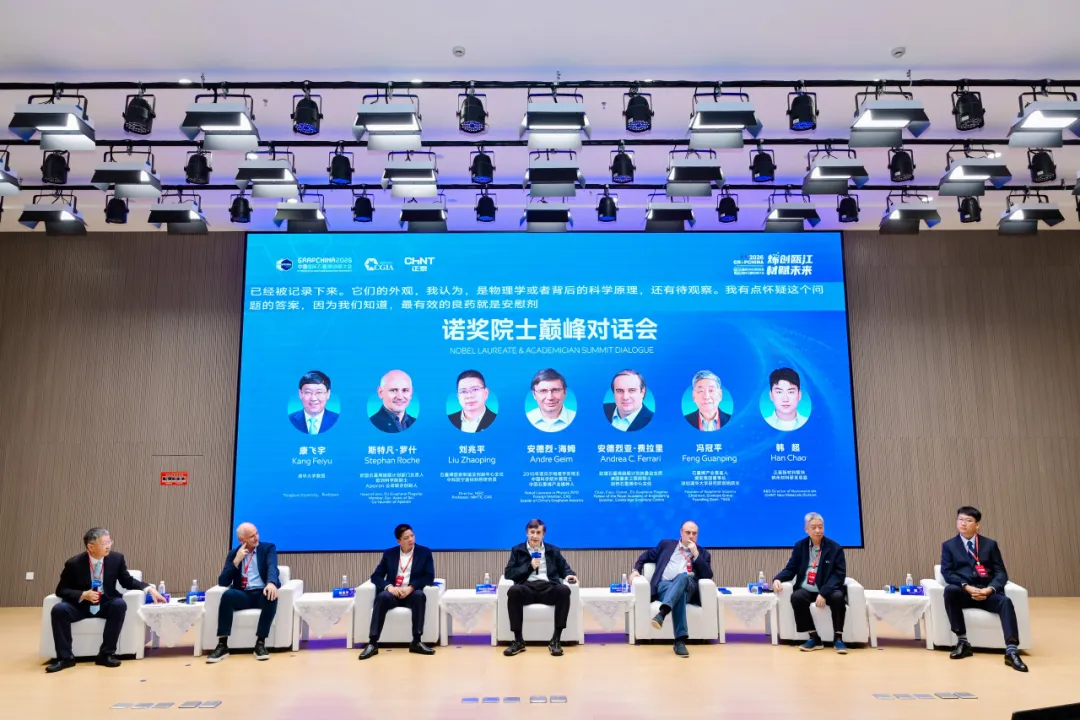
On November 13, the "Nobel Laureate Academician Peak Dialogue" of the 2026 China Graphene Materials Application Expo and China International Graphene Innovation Conference took place as scheduled. At the event, Andre Geim directly confronted a deeper question: 15 years is not a countdown that will automatically come true, but a checklist that must be answered item by item—what does graphene have to offer for the heat dissipation needs of AI computing power; what will bridge the distance from the laboratory to the production line; and where should the next breakthrough in two-dimensional materials be sought. Sharing the stage with him were Andrea C. Ferrari, Chairman of the Executive Board of the EU Graphene Flagship, Fellow of the Royal Academy of Engineering; Stephan Roche, department head of the EU Graphene Flagship and member of the Academia Europaea; Feng Guanping, founder of the graphene industry and Chairman of Xiwang Group; Liu Zhaoping, Director of the National Manufacturing Innovation Center for Graphene; Kang Feiyu, Professor at Tsinghua University; and Han Chao, Director of Nanomaterials R&D at Chint's New Materials Division. Seven guests from the top of global scientific research and the front lines of industry placed graphene within concrete practical coordinates—computing power upgrades, pilot-scale implementation, production line iteration, and the next round of scientific breakthroughs—and engaged in a peak dialogue that directly addressed the "next chapter" of graphene.
At present, AI computing power continues to grow, chip power density keeps rising, and the thermal management problem of data centers is becoming increasingly prominent. Andre Geim stated that new materials are an important foundation for driving the development of computing power and artificial intelligence. Graphene applications have already extended to fields such as heat dissipation in electronic products and lithium batteries, and are being explored in scenarios with higher heat dissipation requirements such as AI chips. Liu Zhaoping offered a similar judgment: with the rapid development of artificial intelligence, embodied intelligence, and other fields, the heat dissipation needs of chips and high-power devices are becoming increasingly urgent, and graphene's application value in this field is growing more important, but overall production line capabilities need to be improved. Andrea C. Ferrari brought another path—not using graphene to conduct heat away, but changing the way heat is generated in the first place. He said that products developed based on graphene can operate efficiently over a wide temperature range, thereby reducing the need for complex and expensive cooling systems.
Regarding the relationship between AI and graphene, Stephan Roche believes that they are more of a virtuous cycle of mutual empowerment: graphene is continuously being applied to AI hardware facilities, and AI software technology can greatly assist new material R&D—AI is placing demands on graphene and also helping graphene answer those demands.
The distance from materials to the production line is measured by another set of scenarios. At the dialogue, Feng Guanping pointed out from the perspective of healthcare that graphene's application in the treatment of major diseases has begun to show results, and called on the industry to broaden its horizons while continuing to invest.
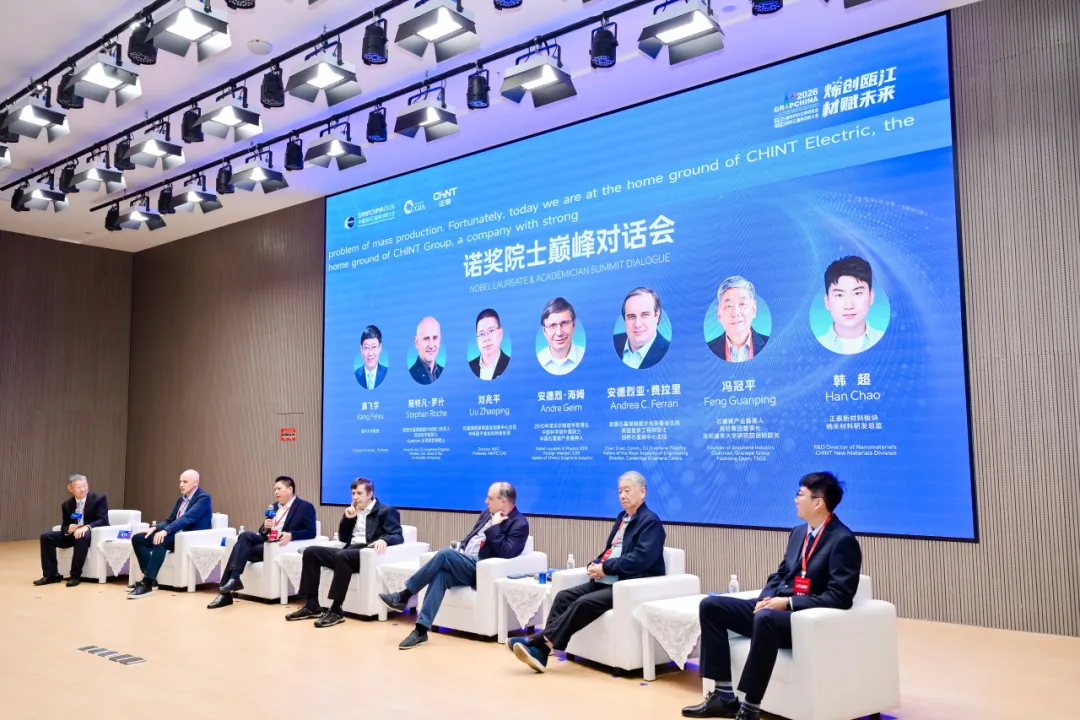
"The end of AI is computing power, and the end of computing power is electricity." Starting from the front-line practice of a power and new energy enterprise, Han Chao discussed Chint's innovation exploration over the past decade or more in leveraging graphene's material properties to turn materials into usable forms, turn forms into devices, and make devices easy to use. At present, Chint's graphene new materials have been promoted in fields such as smart electrical equipment, heavy-duty anti-corrosion and heat dissipation coatings, advanced coatings, and lithium batteries, making products operate more stably, last longer, and perform better. He gave an on-site example: Chint's high-quality graphene metal composite technology has achieved comprehensive leaps in the electrical and thermal conductivity and anti-welding performance of core contacts and devices. Over four years, Chint low-voltage products using graphene contacts have exceeded 600 million units in cumulative application.
Looking further ahead, regarding where the next major breakthrough in two-dimensional materials lies, the guests on site also shared their insights. Andrea C. Ferrari believes that heterostructures of two-dimensional materials can stack different materials together, and the breakthrough may not be "another new material being discovered," but rather a new way of combining materials that opens up device functions previously unattainable.
Andre Geim set his sights even further. He stated that graphene's vitality does not lie in always being called a "wonder material," but in how many places where progress previously stalled it can truly be put to use. At present, two-dimensional materials represented by high-quality graphene are demonstrating irreplaceable and far-reaching value in frontier fields such as semiconductor light-emitting devices, electronic information, quantum transport, and superconductivity.
Beyond frontier breakthroughs, Andre Geim also painted a more concrete picture of daily life: graphene helping chips dissipate heat in mobile phones, and graphene improving performance in electric vehicle batteries—"everyone should become a proud owner of graphene products."
From source breakthroughs in basic research to tackling hard problems on the industrialization front line, from the iteration of scientific research paradigms to predictions of future technologies, this Nobel dialogue gathered global intellectual resources, clarified the boundaries of industry opportunities and risks, provided intellectual增量 for the original innovation, commercialization of results, and ecosystem cultivation of graphene and two-dimensional materials, and injected momentum for China's new materials industry to seize the initiative in the deep integration of scientific and technological innovation with industrial innovation.
Information sources: China Graphene Industry Alliance (CGIA), Chint Group